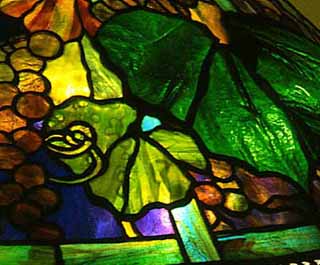
Glass art is that part of the glass industry where glass gets used as an artistic medium. Applications can include stained glass, working glass in a torch flame (lampworking), glass beadmaking, glass casting, glass fusing, and glass blowing.
As a decorative and functional medium, glass was extensively developed in Egypt and Assyria, brought to the fore by the Romans, who developed the art of glassblowing, with the stained glass windows in European cathedrals as living proof of spectacular art and skill. Great ateliers like Tiffany, Lalique, Daum, Gallé, the Corning schools and Steuben Glass Works took glass art to the highest levels.


(Tiffany, Lalique, Steuben)
Glass from Murano (also known as Venetian glass) is the result of hundreds of years of refinement and invention. While there are currently more hotshops and glass artists working in Seattle (USA), Murano is still considered as the birthplace of modern glass art.
Prior to the early 1960s, the term "glass art" referred to glass made for decorative use, usually by teams of factory workers, taking glass from furnaces with a thousand or more pounds of glass. This form of glass art, of which Tiffany and Steuben in the U.S.A., Gallé in France and Hoya Crystal in Japan, Royal Leerdam Crystal in The Netherlands and Kosta Boda in Sweden are perhaps the best known, grew out of the factory system in which all glass objects were hand or mold blown by teams of 4 or more men. The turn of the 19th Century was the height of the old art glass movement while the factory glass blowers were being replaced by mechanical bottle blowing and continuous window glass.
The United States has had two phases of development in glass. The early and mid-1900s had a number of factories such as Fenton, Stuben and others turning out both functional and artistic pieces. The second phase of glass in the United States happened in the 60's when Harvey Littleton, Dominick Labino and Marvin Lipofsky kicked off the studio glass movement by creating small-scale furnaces for the use of glass as an artisic medium. This modern studio glass movement caught on in design schools and Littleton would go on to found the first fine art glass program at the University of Wisconsin at Madison; Marvin Lipofsky, founded the second university-level glass program at the University of California at Berkeley in 1964; and Dale Chihuly initiated the glass program at the Rhode Island School of Design that same year.


(Harvey Littleton, Dominic Labino, Marvin Lipofsky, Dale Chihuly)
As more artists learned from artists before them, a growth of studio art glass spread across the country, with the largest concentration of glass artists working in Seattle. The Pilchuck glass school near Seattle has become a mecca for glass artists from all over the world. Students, who may actually be college students or established artists, have the opportunity to attend masterclasses and exchange skills and information in a environment dedicated solely to glass based arts.