Showing posts with label stained glass. Show all posts

Sunday, May 10, 2009

Development of Studio Glass

Glass art is that part of the glass industry where glass gets used as an artistic medium. Applications can include stained glass, working glass in a torch flame (lampworking), glass beadmaking, glass casting, glass fusing, and glass blowing.

As a decorative and functional medium, glass was extensively developed in Egypt and Assyria, brought to the fore by the Romans, who developed the art of glassblowing, with the stained glass windows in European cathedrals as living proof of spectacular art and skill. Great ateliers like Tiffany, Lalique, Daum, Gallé, the Corning schools and Steuben Glass Works took glass art to the highest levels.
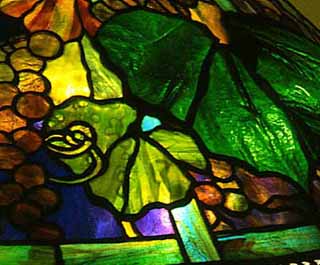
(Tiffany, Lalique, Steuben)

Glass from Murano (also known as Venetian glass) is the result of hundreds of years of refinement and invention. While there are currently more hotshops and glass artists working in Seattle (USA), Murano is still considered as the birthplace of modern glass art.

Prior to the early 1960s, the term "glass art" referred to glass made for decorative use, usually by teams of factory workers, taking glass from furnaces with a thousand or more pounds of glass. This form of glass art, of which Tiffany and Steuben in the U.S.A., Gallé in France and Hoya Crystal in Japan, Royal Leerdam Crystal in The Netherlands and Kosta Boda in Sweden are perhaps the best known, grew out of the factory system in which all glass objects were hand or mold blown by teams of 4 or more men. The turn of the 19th Century was the height of the old art glass movement while the factory glass blowers were being replaced by mechanical bottle blowing and continuous window glass.

The United States has had two phases of development in glass. The early and mid-1900s had a number of factories such as Fenton, Stuben and others turning out both functional and artistic pieces. The second phase of glass in the United States happened in the 60's when Harvey Littleton, Dominick Labino and Marvin Lipofsky kicked off the studio glass movement by creating small-scale furnaces for the use of glass as an artisic medium. This modern studio glass movement caught on in design schools and Littleton would go on to found the first fine art glass program at the University of Wisconsin at Madison; Marvin Lipofsky, founded the second university-level glass program at the University of California at Berkeley in 1964; and Dale Chihuly initiated the glass program at the Rhode Island School of Design that same year.

(Harvey Littleton, Dominic Labino, Marvin Lipofsky, Dale Chihuly)

As more artists learned from artists before them, a growth of studio art glass spread across the country, with the largest concentration of glass artists working in Seattle. The Pilchuck glass school near Seattle has become a mecca for glass artists from all over the world. Students, who may actually be college students or established artists, have the opportunity to attend masterclasses and exchange skills and information in a environment dedicated solely to glass based arts.

Friday, March 13, 2009

Glass maniac

Since doing my B Tech degree at the NMMU (actually from before that time) I was labelled (by my family members!) maniac. I took it in my stride because if maniac means an unstoppable fascination with the subject, then that's all right with me.

In the course of the past 5 years I have bought a small library of books regarding various specific hot and cold glass techniques, but I also bought books that were great for inspiration regarding design ideas: form, colour, shape ... .

I eventually also subscribed to various top glass magazines: Neues Glass, Fjoezz (which used to be "this side up"), Glashaus and Glass Art (which has stained glass aspects over and above the kiln working glass techniques.) Some magazines focus on the artists, feature interviews and description of their work, other magazine add articles and photo instructions about techniques. Only one would not be enough to grasp the great possibilities of working with glass, as many glass artists combine techniques to bring out various characteristics of the glass.

Even though I'm not full time busy with my glass (due to circumstances), I still get a thrill every time I grab a book and I can't wait for every new edition of my subscriptions.

Monday, January 19, 2009

Learning about Glass.

As I had decided that I wanted to do more than flame working and bead making, and find other ways to learn about glass, I had to figure out how.

Unfortunately, I live in Port Elizabeth, far away from other major cities where more glass oriented courses or possibilities are on offer, and it would have been quite impossible for me (with fully established family, school and husband work commitments) to sign up for a 7 year apprenticeship in a hot shop in Cape Town.

After some research about what was on offer in our own town, I signed up for an 8 week Stained Glass Evening Course at the fine art department of NMMU. Although stained glass was not my first passion, this was a step I had to take in order to start connecting with fellow glass enthusiasts. And boy, did it pay off! I learned so much about various sorts of glass, glass cutting tools and techniques, grinding and polishing to get the correct shape, safety and health precautions in the glass workshop, etc. After an initial trial piece to get confidence at cutting glass and leading up, we had to make a properly designed piece, to show we had indeed mastered the basic cutting and leading techniques. My small trial piece was quite abstract, but for my second piece I took inspiration from theKoisan rockpaintings.

Amanda, our teacher and a wonderful glass artist in her own right, burst at the seams with enthusiasm about the possibilities of working with glass and before my term course was over, we’d spent many hours chatting about why I was there and what I wanted to achieve.

She eventually convinced me to enrol as a full time student (lucky me, I was not working and actually could do this) to work intensively with glass and learn as much as possible about all the different aspects of cold and warm glass techniques.

Although I was scared out of my wits, it was the most important step I had made in many, many years and was looking forward to exciting change in my life.